
Expanding Programmatic Revenue by Transitioning from Reseller to Direct Monetization
Postimees Grupp has been one of Estonia’s largest players in the programmatic market for many years. Estonia’s online advertising market is competitive, and media houses must continually innovate to sustain revenue growth. Despite a strong partnership with Google and a deep understanding of market dynamics, Postimees Grupp observed that its programmatic revenue growth had stalled.
Despite stable performance, the Postimees team identified untapped opportunities but struggled to find a solution that was both practical and scalable. It became increasingly clear that expanding programmatic revenue growth would depend on introducing greater competition into auctions and gaining deeper insight into market demand. Like many mature publishers, Postimees Grupp faced a familiar challenge: unlocking additional value from its inventory while maintaining control, transparency, and operational efficiency.
Identifying the Opportunity
As Postimees Grupp’s programmatic business matured, relying mainly on Google exposed key limitations. Although Google remained a strong source of demand, a single-auction environment restricted competition and reduced visibility into broader market valuations.
Industry trends and performance data indicate that direct SSP connections and Supply Path Optimization (SPO) improve auction efficiency compared with relying on resellers. Allowing multiple demand sources to compete directly increases transparency, provides better insight into buyer behavior, and raises yield per impression.
For Postimees Grupp, this shift was about more than incremental revenue. Direct monetization also enabled diversification, reduced risk, and provided greater control over programmatic operations, allowing the publisher to optimize performance across all inventory.
Implementing Direct Monetization to Expand Programmatic Revenue
For Postimees, moving to direct monetization and header bidding felt like the right next step to unlock additional growth opportunities in online sales, as direct SSPs perform better when connected and customized, creating a more competitive marketplace and maximizing revenue. This limitation presented the perfect opportunity to diversify beyond Google and achieve growth. The goal wasn’t just incremental revenue; it was also about gaining transparency and control over who buys their inventory, when, and at what price.
Postimees Grupp explored two options: developing a header-bidding solution and either implementing direct monetization internally or partnering with a specialist. Building in-house offered full control but required significant engineering resources and time. Partnering offered faster implementation, lower technical risk, and access to proven expertise. After evaluating several providers, Setupad stood out for its open platform and transparency, which aligned perfectly with Postimees Grupp’s goals. For Postimees, partnering was clearly the faster and more convenient option.
Kristjan Pillak, Head of Product Development: ‘’Most providers we spoke with offered closed systems, where, as a media house, you only see limited, high-level reporting, essentially how much inventory was sold and at what price. At the end of the month, you receive an invoice and are expected to be satisfied with the result.’’
Setupad provided an open platform that offered full transparency into programmatic operations, allowing publishers to see exactly who was buying Postimees’ inventory, at what price, and in real time. This visibility enabled Postimees to optimize yield rather than passively wait for monthly invoices. With Setupad’s support, they were able to solve more complex integration challenges and establish their first direct relationships with multiple SSPs. As a result of this collaboration, Postimees added all major SSPs to their sales stack and also leveraged additional networks facilitated by Setupad, further enhancing their revenue potential.
The platform also allowed direct participation in shaping the programmatic setup, enabling granular performance analysis and strategy adjustments. This approach aligned with Postimees Grupp’s objective of actively managing and developing its programmatic business rather than outsourcing decision-making entirely.
27% Growth: Successfully Expanding Programmatic Revenue
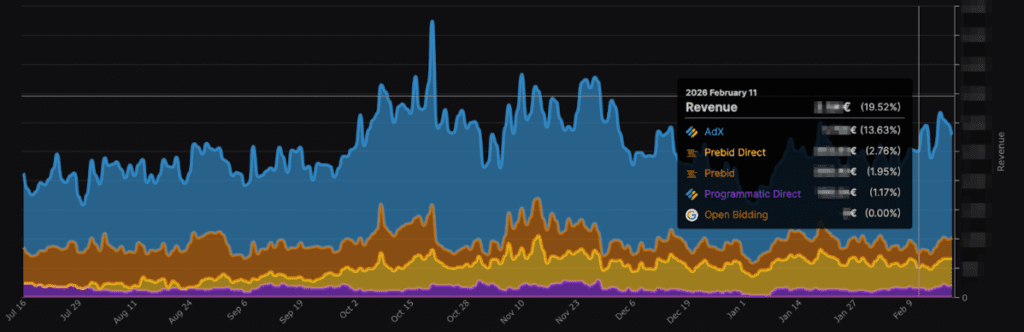
Within one year of implementing direct monetization with Setupad, Postimees Grupp had increased its programmatic revenue by 27%. This growth exceeded expectations, demonstrating the effectiveness of a diversified, transparent auction environment.
Beyond revenue uplift, the company achieved several strategic benefits:
- Tested and fully onboarded within the first 45 days
- 12 SSPs migrated within the next 2 months after onboarding
- >70% of Prebid demand is from the direct connections
- Clarity of the programmatic demand behavior
These outcomes strengthened Postimees Grupp’s programmatic business and positioned it for sustainable future growth.
Direct Monetization in Practice
Postimees’ experience demonstrates that transitioning from reseller to direct monetization is most effective when pursued as an active business strategy rather than as a purely technical integration. While relying on a few direct SSPs may underperform relative to a larger reseller network, 6 direct SSPs would not outperform 15 resellers in both server- and client-side setups. So it’s the business-focused approach that changes the outcome. By actively managing demand relationships, ensuring transparency, and leveraging detailed data, publishers can optimize performance, increase fill rates, and ultimately unlock higher yields from programmatic revenue.
For media companies that actively manage their programmatic operations, solutions like Setupad can accelerate implementation, reduce development complexity, and support more diversified and resilient revenue models. A common concern is that transitioning to direct monetization is resource-heavy and time-consuming; however, Setupad effectively minimizes this overhead. Because we maintain established reseller accounts and handle the technical heavy lifting, even non-technical team members can launch and manage the setup independently. Combining the right technology with strategic oversight allows publishers to bypass the need for a large dev team and establish a future-proof programmatic revenue approach without the expected operational strain.