
Solving the Ad Ops Blindspot: Automated Ad Discrepancy Tracking and Revenue Recovery
For many publishers, a silent leak in their tech stack is draining profits right under their noses. This leak doesn’t stem from low fill rates or poor floor prices, but from a systemic misalignment between two core pieces of infrastructure: Supply-Side Platforms (SSPs) and Google Ad Manager (GAM), making proactive ad discrepancy tracking an absolute necessity.
When the revenue and impression data reported by an SSP don’t match what is logged inside your primary ad server, you are facing an ad discrepancy. Left unmonitored, these discrepancies can quietly result in over a 10% revenue loss for publishers. For publishers and Ad Ops teams operating on tight margins, identifying, tracking, and neutralizing these variances isn’t just a maintenance task – it is a critical requirement for yield protection.
What Are Ad Discrepancies and Why Do They Happen?
A revenue or impression discrepancy is the difference between what GAM registers as delivered and what an SSP claims to have bought and paid for.
While a 1% to 3% variance can be attributed to natural internet noise, double-digit variances point to deeper underlying issues. These data gaps arise because programmatic infrastructure relies on a chain of independent technologies, each executing different logic within milliseconds.
For a complete breakdown of how to calculate variances and a deep dive into the 12 most common triggers, including ad blockers and page caching, read our foundational guide: What is Ad Discrepancy and How to Reduce It.
The Technical Root Causes
While data discrepancies can technically swing in either direction, appearing as positive or negative variances relative to Google Ad Manager (GAM) data, the primary threat to a publisher’s bottom line is almost always a heavy negative gap. These negative discrepancies represent a direct revenue leak: GAM logs a winning auction on their end, but the SSP never records the impression delivery. Ultimately, this means the publisher is missing out on payouts for auctions it has already won.
To diagnose and resolve these imbalances, publishers must look at the specific technical friction points driving them:
- Impressions vs. Rendered Impressions: A common source of discrepancies is that GAM and SSPs may count impressions at different stages of the ad delivery process. GAM typically records an impression when the creative begins rendering according to Google’s impression-counting methodology. Some SSPs, however, rely on their own impression trackers or beacons to confirm delivery. If the SSP’s tracking pixel fails to fire due to network issues, browser restrictions, ad blockers, or page interruptions, GAM may record an impression while the SSP does not. As a result, GAM can show higher impression counts than the SSP.
- Latency and Tracking Failures: Even after an ad is successfully served and counted by GAM, the SSP may fail to receive the corresponding tracking signal needed to register the impression on its side. This can occur because of latency, client-side script failures, browser privacy protections, or lost tracking requests. In these situations, GAM reports the impression as delivered, whereas the SSP shows no corresponding record, resulting in a discrepancy between the two platforms.
- Incompatible Counting Methodologies: Different platforms deploy unique filtration algorithms for Invalid Traffic (IVT). An SSP might filter out a bot impression retrospectively or use a different standard than Google’s stringent, real-time IVT filtration tools.
- Reporting Delays and Data Freshness: Reporting systems do not update their data simultaneously. Some platforms process and publish results continuously, while others apply updates, adjustments, or reconciliations several hours later. As a result, data for the most recent one to two days may continue to change and can temporarily differ between systems. These discrepancies often resolve as all platforms complete their data processing and reporting cycles.
- Wrapper Integration Friction: Misconfigured key-value pairs, code implementation bugs in custom wrappers, or mismatched currency conversion rates between the wrapper and GAM line items naturally result in warped data.
Ultimately, data is often “wrong” because we are trying to align multiple disconnected platforms using entirely separate logic. When you factor in the inevitability of human setup errors in complex line-item configurations, discrepancies become the norm rather than the exception.
The Reality of Monitoring Ad Discrepancies Manually
For a long time, Ad Ops teams have treated discrepancy tracking as a manual maintenance routine. This approach is no longer viable in modern programmatic setups.
Manual monitoring requires Ad Ops to log in to dozens of individual SSP dashboards, export CSV reports, normalize dates and currencies, and manually match those rows to a corresponding GAM report. In many cases, teams must first create custom GAM reports with specific filters to obtain accurate domain-level data for a particular SSP. They then need to generate matching reports within the SSP itself for the same domains and reporting period before comparing the results. This process must be repeated continuously as reports require regular updates and consolidation into separate tracking spreadsheets. For organizations managing multiple clients with their own GAM instances, the entire workflow must be replicated across each account. It’s an inefficient process that consumes significant operational time and is highly prone to human error.
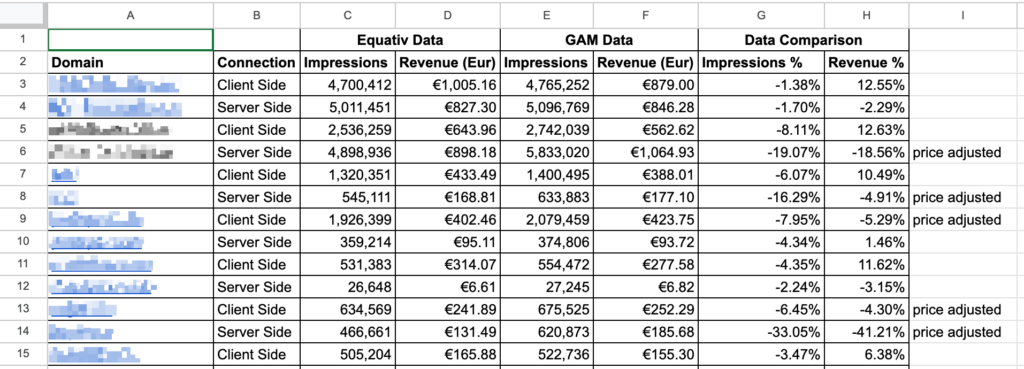
The Operational Blindspot:
Because manual tracking is so resource-intensive, it forces a compromise: selective checks. An AdOps team simply cannot cover every ad unit, every domain, every monetization partner, and every single day of the month. Instead, teams resort to macro-level, retrospective sampling.
This creates massive blind spots. Minor leakage across a smaller SSP or a specific sub-domain goes unnoticed for months. Without 100% inventory visibility, publishers are effectively guessing their true programmatic margins. Furthermore, fragmented data sources and complex UIs impose a heavy operational overhead on engineering and yield teams, diverting them from high-value optimization tasks.
What to Do When You Find Discrepancies.
When a discrepancy is caught, publishers must follow a structured, multi-step playbook to recover lost revenue. To ensure resources are allocated effectively, responses are triggered based on specific thresholds:
- Up to -5% (Acceptable Variance): No action required. Minor fluctuations are standard in baseline reporting and do not warrant intervention.
- Beyond -10% (Moderate Discrepancy): Reduce commission. Scale down the partner’s financial terms to mitigate risk while the root cause is being investigated.
- Beyond -40% (Critical Discrepancy): Disconnect immediately. Shut down the integration or traffic source right away to halt severe revenue bleed.
Step 1: Internal Troubleshooting
Before pointing fingers, audit your setup, cross-reference internal analytics to rule out wrapper misconfigurations. Verify the SSP tags, look for sudden spikes in wrapper timeouts, and check if the discrepancy is isolated to a specific ad format or device type. Determine whether the issue is technical (such as latency or creative errors) or an SSP-side reporting anomaly.
Step 2: Contact the SSP
If your internal audit confirms the wrapper is functioning correctly, open a ticket with the SSP. Provide concrete data evidence (e.g., comparing their reported impressions vs. GAM impressions for the same timeframe). Request a technical audit of their counting logic and establish firm follow-up timelines to ensure financial accountability.
Step 3: Introduce a Price Adjustment (The Revenue Recovery Strategy)
If an SSP acknowledges a structural discrepancy but takes weeks to deploy a fix – or if the variance is a permanent byproduct of their tech stack – you cannot afford to simply absorb the losses. At the same time, turning off the demand partner hurts your auction density.
The solution is to introduce a Price Adjustment.
If an SSP has a proven, consistent discrepancy rate, you apply a proportional multiplier or commission fee to that specific partner’s bidding price within your wrapper settings, which can be handled natively using Prebid.js bidder settings functionality.
How it works in practice: Imagine an SSP bids $1.00 in the header bidding auction. Still, due to a structural 30% discrepancy (caused by latency or counting differences), you only actually receive $0.70 in net value once the data clears in GAM. To neutralize this, you apply a -30% price adjustment factor to their bid in your wrapper. To win an auction that requires a true $.70 clearing price, the SSP must now bid $1.
Why this works:
- Real-Time Compensation: It instantly protects your yield by forcing the discrepancy-heavy partner to pay a premium that offsets their reporting leakage.
- True Value Realization: It levels the playing field in the unified auction, aligning the SSP’s bidding power with the actual financial value they ultimately deliver to your bank account.
- Preserves Demand Density: You do not have to resort to the drastic measure of removing demand partners, keeping your auction highly competitive.
Introducing Setupads Ad Discrepancy Tracking Solution
Publishers shouldn’t need a dedicated team of data scientists just to ensure they’re paid accurately. Our solution was built to eliminate the manual friction of yield protection completely.
What Our Tool Does:
- Discrepancy Monitoring directly from the Client UI: Our engine integrates directly with your GAM instance and SSP stack via secure APIs. It tracks every impression and revenue across 100% of your inventory, operating continuously in the background.
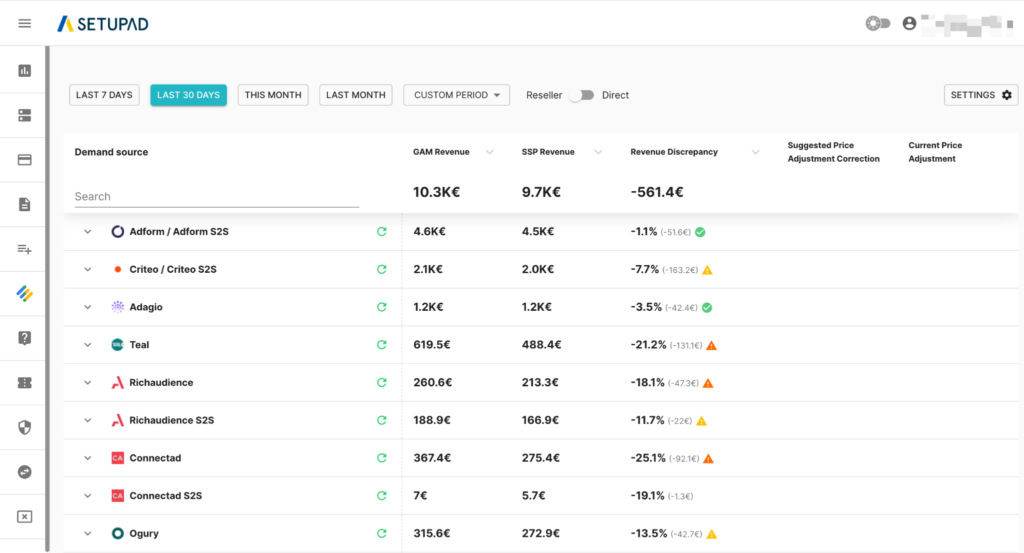
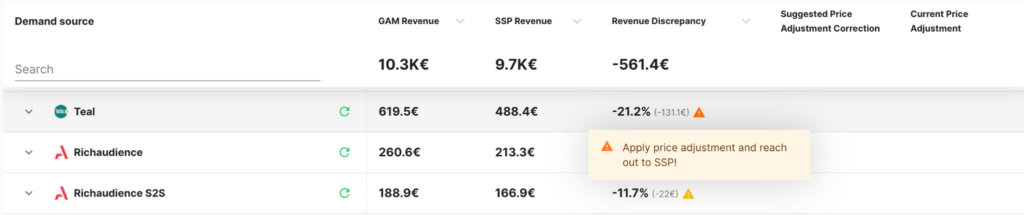
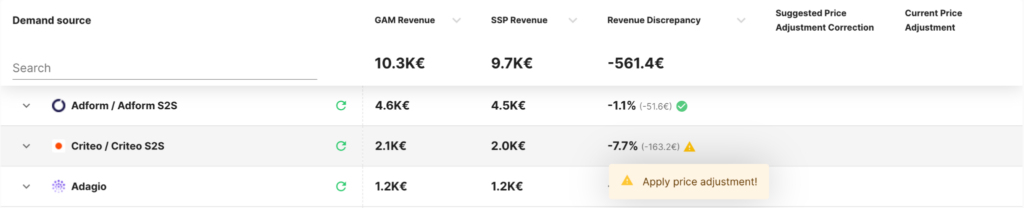
- Smart Alerts: Built-in prompts that help you optimize pricing and manage SSPs with zero guesswork.
- Price adjustment suggestions: Selecting an SSP automatically surfaces domain-specific price-correction recommendations, allowing you to compare suggested price optimizations with your active adjustments in real time.
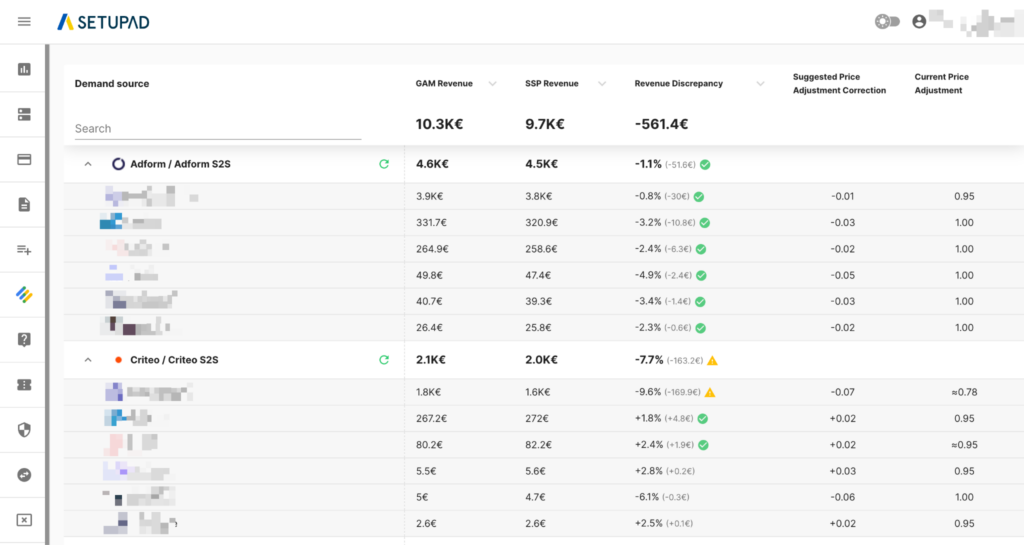
By shifting from manual oversight to automated engineering, publishers achieve three immediate wins: zero missed revenue leaks, a drastic reduction in manual Ad Ops labor, and an immediate, measurable increase in net programmatic revenue.
Conclusion
In modern programmatic advertising, ad discrepancies are inevitable, but allowing them to affect revenue is entirely optional. As monetization architectures grow more complex, relying on spreadsheets and occasional manual checks is no longer enough to protect your yield.
By combining automated data ingestion with tactical real-time price adjustments, publishers can effectively neutralize financial leakage, streamline their operational workflows, and ensure they are paid for every single impression they deliver.