
Smart Ad Refresh: Maximize Publisher Revenue Safely
Without ad refresh, your inventory is permanently limited to the initial page load. Even the most advanced header bidding setups leave money on the table if the monetization opportunity ends while the user is still actively engaged on the page. Setupad Smart ad refresh solves this by generating new ad impressions throughout a user’s session, unlocking otherwise unused inventory, and extending the value of every visit.
Publishers leave money on the table when treating ad refresh as a simple timer, which is a mistake. Refreshing ads every 30 seconds, regardless of user behavior, doesn’t just annoy users – it signals to Google and SSPs that your inventory is low-quality. A standard “blind” refresh tanks your viewability, which signals to SSPs that your inventory is low-quality. The result? Advertisers bid less, and your total revenue drops over time.
What is Smart Ad Refresh?
Smart ad refresh (or auto-refresh) serves new ads to a user during a single session without reloading the page. Unlike basic background timers, smart refresh uses strict eligibility triggers:
- Viewability Thresholds (e.g., ≥50% of the ad pixels are actively in-view).
- Exposure Duration (e.g., continuous exposure for 30 seconds).
- User Activity (e.g., scrolling, active tab status, page interactions).
It applies to both programmatic and direct campaigns, transforming refresh from a static code feature into an attention-based monetization strategy.
The Core Mechanics & Data
Smart refresh directly increases total impressions per session. Traditional setups typically limit inventory to 3 impressions per pageview because standard ad slots only load once. However, if a user is on a highly engaging page, such as a long article, a forum, or a tools page, for 2 to 3 minutes, a 30-second viewability-based refresh trigger will naturally turn a single static ad into 3 or 4 impressions during that session. Across a standard page layout with 3 banners, your total impressions shift from 3 to 9 or even 12. By unlocking these hidden layers of engagement, that same session can yield an additional 15% to 70% in total available inventory.
To ensure inventory quality, smart refresh relies on:
- Viewability-First logic: Confirms the ad unit is actually visible before triggering a request.
- Active Engagement Monitoring: The refresh pauses immediately if the user switches tabs, minimizes the window, or leaves the page area.
- Dev-Tools Detection: Crucially, the refresh pauses if a user opens developer tools, preventing “ghost” impressions that dilute your metrics.
- Policy Compliance: Auto-refreshing inventory must be explicitly declared in Google Ad Manager (AdX) and is generally prohibited on baseline Google AdSense.
The Value for Publishers
Implementing smart refresh significantly increases total ad impressions. Because revenue growth is tightly tied to eCPM, using an algorithm that maintains a steady CPM across refreshed placements ensures your ad revenue scales proportionally with your impression volume (which often accounts for 15-70% of total ad revenue in high-engagement environments). Furthermore, this expanded inventory allows your direct campaigns to be served much more frequently. Rather than mindlessly inflating volume, smart refresh distributes high-quality, high-viewability impressions across periods of sustained user engagement.
The Value for Advertisers
Controlled refresh improves campaign efficiency. By serving ads only during active attention windows, advertisers benefit from:
- Improved ad Engagement: The refreshed ad impressions received roughly 20% more clicks than the initial ad impressions, according to Setupad data.
- Improved viewability: Strict refresh triggers deliver better viewability because the system confirms the initial impression is already on the user’s screen.


By leveraging Google Ad Manager (GAM) data, we see that controlled refresh directly optimizes the two metrics most critical to advertisers: CTR and Viewability. Unlike standard timers, our logic only triggers a refresh when the ad unit is actively in-view and the user is engaged with the page. According to our GAM Active View reports, this ensures that refreshed impressions maintain high viewability rates because the “initial” impression was already confirmed visible. Furthermore, this “active attention” window results in higher engagement; GAM performance data show that these refreshed impressions frequently achieve a higher CTR than static placements, as the delivery of a new creative captures fresh user interest precisely when they are most likely to interact.
Refreshed Impressions vs. Initial Impressions
- Initial Impressions: Constrained to the initial layout. They contain a mix of high- and low-attention moments depending on immediate user behavior.
- Refreshed Impressions: Generated during active engagement, specifically targeting users who remain on a page for 30 seconds or more. Since users who reach this threshold are statistically likely to stay longer, these ads provide a substantial boost to CTR and viewability compared to the 1-second industry minimum. Success depends on tight control, as poor timing negatively impacts performance.
Choosing the Right Smart Ad Refresh Intervals
When optimizing your refresh strategy, everything hinges on active time spent and the market reaction. If you analyze your data and see a lower eCPM, the fix is straightforward: decrease the total number of refreshes by increasing the refresh interval.
However, your starting point and your scaling limits will depend entirely on your specific environment, as refresh frequency must always reflect actual user attention spans:
- Long-Session Environments (Gaming, Video, Utility Tools): Users typically spend more time and remain highly engaged with a page. This allows for deeper refresh cycles and can result in a 30%–50% increase in inventory.
- Short-Session/High-Frequency Environments (News, Blogs, Portals): In fast-paced media environments, user behavior changes. Readers consume content quickly and exit. To avoid tanking your eCPM here, you must use a more conservative refresh interval, which typically leads to a safer 15% inventory uplift.
Refresh Timeout Strategy
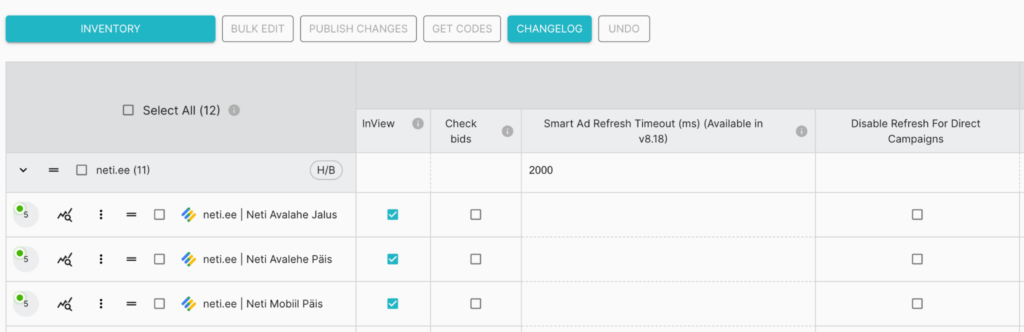
Unlike initial ad loads, refresh auctions allow slightly longer timeouts (2 to 3 seconds) without impacting page load speed. The optimization challenge is balancing the timeout: you must give SSPs enough time to bid while ensuring the auction completes before the user leaves the page.
One of the biggest advantages of smart refresh is the auction duration. Unlike the initial page load, where speed is critical for UX, a refresh auction can wait.
The 3-Second Rule: We often allow refresh auctions to last up to 3000ms.
Why? The user is already on the page and can wait. A longer timeout gives bidders more time to respond, leading to higher bid density and higher yield.
The Challenge of Implementation
Building a smart refresh system in-house drains engineering resources and introduces severe technical hurdles:
- Complex Tracking: Requires precise Intersection Observer API implementation to prevent false or latent refreshes.
- State Signals: The wrapper must flawlessly track tab focus, scrolling, and micro-interactions.
- Header Bidding Sync: Must trigger new Prebid auctions without lagging the page or causing timeout errors.
- GAM Policy Risks: Misconfiguration risk, AdX policy violations, and disabled serving.
How Setupad Simplifies Smart Ad Refresh
Setupad provides a semi-automated, policy-compliant solution to safely scale inventory without harming eCPM:
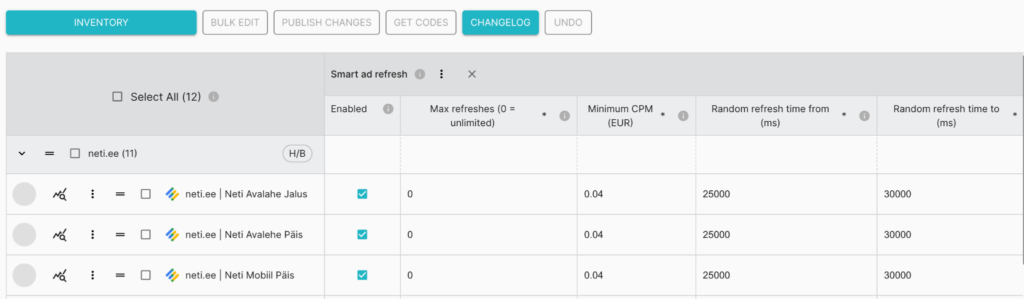
- Adjusting the milliseconds interval of the refresh trigger based on the average user session duration. Strict Viewability Optimization: Refreshes only slots that are actively viewed, preventing wasted impressions.
- Individual smart ad refresh timeouts for managing refreshed auction timeouts.
- Actionable Reporting & Real-Time Analytics: Tracks revenue, fill rates, and inventory growth across specific refresh cycles. Integrated with real-time Prebid analytics, it allows publishers to monitor live eCPM fluctuations throughout the bid lifecycle, ensuring immediate data-driven adjustments to prevent price dilution.
- Option to disable refresh for direct campaigns.
Direct Campaigns & Smart Ad Refresh Floor Prices
Direct Campaigns
Direct deals benefit significantly from the extended exposure provided by smart refresh. Because refreshes trigger only after sustained engagement (such as a 30-second stay), these impressions often yield higher viewability and CTR than initial impressions. While the system allows refresh to be disabled for specific units if contractually required, keeping it enabled generally increases high-quality inventory for both programmatic and direct deals.
Smart Ad Refresh & Floor Prices
If SSPs bid weakly on refreshed inventory, publishers can apply floor prices to protect yield. However, use this cautiously, as improper floors will heavily suppress fill rates. The biggest drawback, and the reason many avoid this strategy entirely, is that Google Ad Exchange (AdX) is not working, since it doesn’t disclose the bid prices and can no longer participate in the auction.
Conclusion
Smart ad refresh shifts monetization from static page views to dynamic user attention. When optimized for viewability, engagement, and auction dynamics, it safely maximizes session value and drives significant revenue growth without compromising advertiser performance.